


X


Tagore the Storyteller
Bringing Rabindranath Tagore’s ideas to 10,000+ students across 20 schools


To celebrate its Golden Jubilee, Shahana – Tagore Centre for Indian Music and Culture partnered with School Chameleons to take the ideas of Rabindranath Tagore into schools through storytelling, performance, and creative expression.
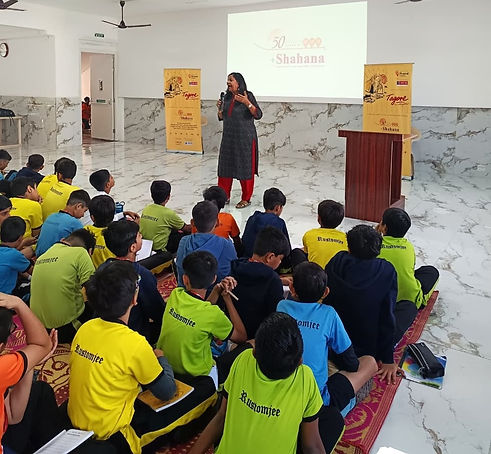
The programme, Tagore the Storyteller, introduced middle school students to Tagore’s philosophy of empathy, equality, imagination, and independent thinking through interactive storytelling workshops.
Across 20 schools in Mumbai, students explored how stories can inspire reflection, creativity, and social awareness.

Impact at a Glance


The Idea
For over 50 years, Shahana has celebrated the vision of Rabindranath Tagore through music, dance, and performance.
Tagore the Storyteller extended this legacy into schools.
Through storytelling sessions, students were introduced to Tagore not just as a Nobel Prize–winning writer, but as a thinker whose ideas about human dignity, equality, and imagination remain deeply relevant today.
The programme encouraged students to reflect on these themes and express their own ideas through storytelling.


The Programme
Each school hosted a one-hour interactive storytelling workshop designed for students in Grades 6–8.
Students explored Tagore’s ideas through excerpts from Shahana’s dance productions, including:
-
Manavkanya
A story highlighting empathy and inclusion, encouraging students to reflect on compassion and acceptance. -
Elem Notun Deshe
A piece exploring independent thinking and the courage to imagine new possibilities. -
Rajendranandini
A narrative celebrating women’s strength and the importance of gender equality.
These stories sparked conversations about social values and helped students see how storytelling can communicate powerful ideas.
Learning Through Storytelling
The workshop also included a mini masterclass titled:
“What Makes a Good Story?”
Students learned simple storytelling tools including:
-
Building characters
-
Structuring a narrative
-
Expressing emotions through stories
-
Using storytelling to communicate ideas and values


Student Engagement
Students were invited to participate in two creative competitions:
Storytelling Competition
A Tagore Story in Your Voice
Creative Writing Competition
Stories for Social Change
Schools conducted internal rounds and nominated their best entries for the inter-school grand finale.
Grand Finale: Voices of Tagore
The programme culminated in the Inter-School Storytelling Competition – Voices of Tagore, held at the Mini Auditorium, PL Deshpande Academy.
Students from participating schools presented their stories before a live audience of students, teachers, and parents.
The event celebrated creativity, confidence, and the power of storytelling to inspire change.

Celebrating Every Young Voice
The creativity and thoughtfulness of the student submissions made it clear that limiting recognition to only a few winners would not fully honour their work.
Instead, every participating student received a special storybook featuring their own written story.
For many students, this was their first experience seeing their writing published, making the programme both memorable and meaningful.
What Educators Said
“The programme beautifully illuminated Tagore’s multifaceted contributions as a poet, storyteller, artist, dramatist, and visionary educator.”
— Ajmera Global School
“The session was fun-filled, interactive and full of excitement.”
— Principal, Rustomjee School
“It was a very informative session. The points told by the speaker, Ms. Swapnali were according to the level of the students. The students were engrossed in knowing about the fine points of storytelling and writing. There was active participation by the students. Overall an excellent session.
— Sr. Snehanjali A. C.
Principal,

A Legacy That Continues
Through Tagore the Storyteller, thousands of students discovered that stories are not just something we read.
They are tools to think, imagine, question, and create change.
By bringing Tagore’s ideas into classrooms, the programme helped young people see the world, and their own voices, in new ways.